

E-commerce Websites in 2026: 5 Incredible Trends for Ultimate Success
Optimizing e-commerce websites for the upcoming shifts in 2026 demands radical changes in how digital brands engineer their online storefronts.
Your digital storefront is no longer just a simple administrative catalog. It is rapidly evolving into an autonomous, intelligent ecosystem capable of reacting to buyer micro-intents instantly.
Failing to adapt your current code architecture to these new baselines will result in high bounce rates, severe cart abandonment, and lost search engine visibility.
Next-generation e-commerce websites must optimize perfectly for automated AI search engine bots while maintaining clean, instantaneous user interaction loops.
The digital software horizon is witnessing an absolute technical transformation. Generic design themes are now being systematically replaced by highly efficient composable backend engines.
In this comprehensive guide, we explore the core parameters driving modern e-commerce websites to prepare your business platform for the ultimate shift in digital consumer behavior.
Table of Contents
- — Why Planning for E-commerce Websites in 2026 is Vital
- — 1. Agentic AI Commerce Integration
- — 2. Bento Grid Layouts & Premium Visuals
- — 3. Headless & Composable Infrastructures
- — 4. Frictionless Mobile Biometric Checkouts
- — 5. Answer Engine Optimization (AEO) Readiness
- — Core Performance Benchmarks for Modern Stores
- — Evaluation Matrix for E-commerce Websites
Why Planning for E-commerce Websites in 2026 is Vital
Digital conversion spaces are no longer governed by simple keyword searches or static product filtering rules.
Modern online buyers demand immediate, contextual product recommendations that fit their lifestyle parameters without forcing them to spend hours browsing broad product archives.
This structural migration makes tracking the evolution of e-commerce websites essential, as consumer interactions pivot from manual filtering toward personalized, automated curation streams.
Furthermore, leading search platforms have locked in advanced rendering guidelines as direct ranking signals. You can check the official Google Core Web Vitals Guidelines to see how missing these performance targets directly lowers organic traffic.
To ensure your visual components load cleanly alongside these technical elements, pairing an optimized database with our specialized, high-performance E-commerce Websites Templates creates an ideal foundation for fast page delivery.
5 Definitive Pillars Shaping E-commerce Websites in 2026
The following detailed analysis addresses the exact operational features you must integrate into your design infrastructure to meet the modern standards of digital retail.
1. Agentic AI Commerce – Turning E-commerce Websites into Autonomous Sales Channels
Agentic technology transforms user support spaces, converting basic text plugins into autonomous systems that proactively assist consumers through their purchasing journey.
Rather than relying on basic automated scripts, these tools connect with your warehouse management systems to perform complex actions on behalf of the customer.
They can evaluate custom promotional values, cross-reference fits against multi-brand historic measurements, and complete product exchanges without manual human support intervention.
When engineering high-converting e-commerce websites, hosting custom machine learning integrations on your storefront dramatically lowers operational overhead while increasing your average order values.
The system shifts from an annoying text pop-up to an immersive discovery funnel, helping users build tailored orders matching vague, long-tail conversational inputs.
Why deploy Agentic AI engines?
It provides an effortless blend of highly specialized customer assistance and scalable cloud automation, optimizing user retention paths round-the-clock.
Core operational attributes:
- Interactive voice interactions capable of resolving complex user requests
- Real-time automated bundle pricing adjusted dynamically during live sessions
- Instant handling of shipping updates and complex order returns

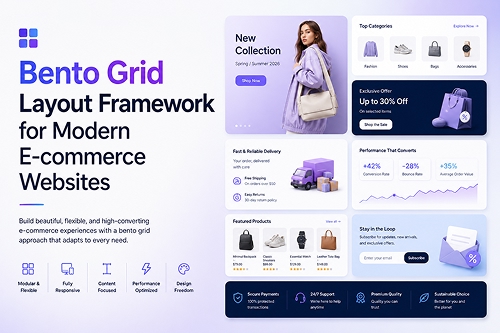
2. Bento Grid Layouts – Immersive Front-End Spaces for E-commerce Websites
The front-end design philosophy of contemporary platforms embraces a modular approach through clean, structured blocks commonly known as Bento Grids.
This layout organizes varied content blocks seamlessly on small screens, allowing modern e-commerce websites to display short video clips, real-time store inventory warnings, and conversion buttons inside a single view.
Complementing this modular grid is a widespread move toward sophisticated dark themes, which luxury and lifestyle labels use to make high-definition product photography stand out cleanly.
This visual setup makes the website experience feel identical to using a premium mobile application, eliminating the awkward page shifts found in legacy setups.
Delightful structural movements triggered as users navigate downward help share the brand story organically, keeping visitors on-site longer and lowering accidental bounces.
Why adopt modern Bento Grid designs?
It creates an immediate premium brand impression, handles multiple rich media files simultaneously, and gathers key specifications into clear, digestible sections.
Core operational attributes:
- Responsive container cards that shift fluidly to fit any user monitor layout
- Optimized styling that focuses user vision toward prominent action links
- Seamless loops of video content placed naturally next to cart buttons
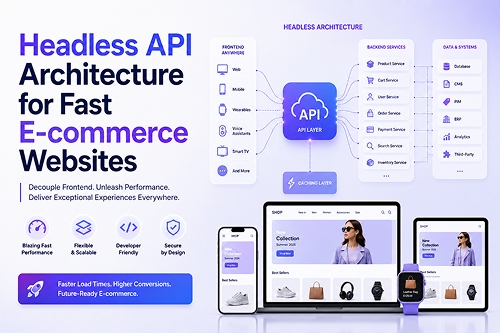
3. Headless Architecture – Accelerating E-commerce Websites with Sub-Second APIs
In high-volume digital sales spaces, running a modern database separate from your visual layer has evolved from a complex luxury into a core operational requirement.
By splitting your frontend design away from your data management backend, headless networks deploy ultra-fast page layouts built through global processing frameworks.
This architectural foundation is central to scaling modern e-commerce websites, using fast edge servers to transmit price files and cart states over microservices without loading delays.
This modular style gives developers the freedom to swap external tools as needed: plugging in specialized checkouts, dedicated media hubs, or cloud-based search systems without friction.
This engineering freedom lets growth teams modify consumer-facing landing pages immediately without risking any database instabilities inside the core checkout code.
Why switch to Composable headless layers?
It provides incredible site speeds under one second, hits perfect optimization scores, and keeps database processes stable during sudden promotional traffic spikes.
Core operational attributes:
- Isolated front-end layer layouts that prevent backend database security risks
- Unified content publishing across standard browsers, smartwatches, and store screens
- Modular API designs that eliminate platform lock-in constraints entirely
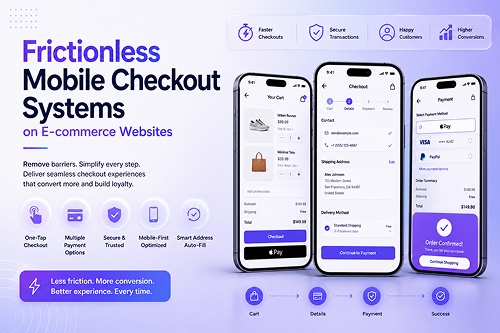
4. Frictionless Mobile Checkouts – Enhancing E-commerce Websites Transactions
Smartphones represent the absolute majority of digital retail engagements, focusing developmental workflows squarely onto frictionless checkout mechanics.
Exhaustive registration steps, manual address fields, and confusing order review pages are being systematically removed from modern conversion paths.
Modern checkouts quickly confirm shipping details and payment credentials using secure biometric verification systems like FaceID or fingerprint scanning embedded in the device browser.
Next-gen cart code handles localized shipping computations in the background, showing precise regional taxes and active discount milestones without refreshing the page.
To reduce abandonment metrics across modern e-commerce websites, layouts focus entirely on comfortable one-handed navigation, placing payment triggers directly within the natural thumb scanning zone.
Why deploy biometric transaction layouts?
It captures purchases at the exact peak of consumer intent, driving cart abandonment rates down while multiplying conversions from social ad traffic.
Core operational attributes:
- Native integration with device passkeys for secure, instant conversion confirmations
- Automated address mapping utilizing system GPS location confirmations
- Deep integration with digital wallet networks and flexible pay-later features
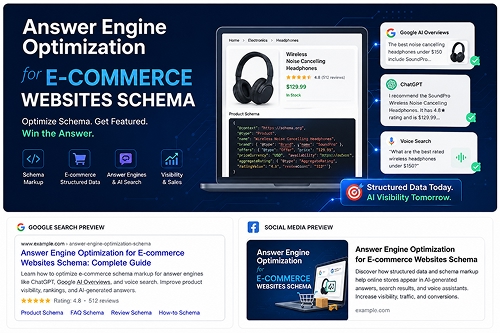
5. Answer Engine Optimization (AEO) – Engineering E-commerce Websites for AI Bots
As standard web searching transforms into conversational summaries through large models, traditional search indexing morphs into Answer Engine Optimization (AEO).
Store owners can no longer simply fill text with short key phrases; they must design structural metadata to answer long, contextual questions asked by consumer AI agents.
To win recommendations within AI search summaries, high-performing e-commerce websites rely on rich schema data that itemizes sourcing details, real user tests, and precise material records.
AEO upgrades standard catalogs into a deeply mapped knowledge base, clearly presenting why a specific product satisfies a user’s exact daily application parameters.
Internally, store search fields are replacing old text matching with conversational AI modules, bringing up accurate results even when buyers input vague phrases or picture uploads.
Why build your code around AEO principles?
It ensures your catalog is chosen as a primary citation source when search algorithms build retail recommendations, securing premium organic customer traffic.
Core operational attributes:
- Advanced Product & FAQ Schema modules built for easy machine ingestion
- Internal site search boxes supporting natural phrasing and visual image lookups
- Secure verification setups that protect user product reviews from spam manipulation
Core Performance Benchmarks for Modern E-commerce Websites
Building a robust platform ready for future demands requires meeting strict requirements across file compression scales and script handling paths.
Server-side data delivery speeds remain critical. Online stores should run on distributed server networks paired with edge-caching architectures to serve media assets, 3D graphics, and live interactions without latency.
Auto-scaling server setups are mandatory to prevent page crashes when viral social media trends drive sudden waves of concurrent buyers to your checkout nodes.
Additionally, building code according to international accessible design rules ensures your web properties remain accessible to all users. To review these digital standard protocols, explore the W3C Web Accessibility Guidelines to build an inclusive digital store.
Evaluation Matrix for E-commerce Websites
Review the primary changes between outdated retail platforms and modern technical architectures engineered for long-term scalability.
| Technical Priority | Legacy Digital Setup | Modern E-commerce Architecture |
|---|---|---|
| System Framework | Monolithic engines with connected code layers | Headless & Composable Stacks via decoupled APIs |
| User Assistance | Linear decision-tree popups using basic text match | Agentic AI Commerce with real-time backend tool access |
| Frontend Design | Standard row lists and repetitive vertical page grids | Bento Grid Systems & Dark Aesthetics with app-like cells |
| Checkout Loop | Multi-page form forms requiring password setups | Biometric-secured One-Click and Zero-Click Checkouts |
| SEO Framework | Basic keyword placement targeted at legacy indexes | Answer Engine Optimization (AEO) built for AI bots |
Strategic Advantages of Updating Your Storefront Core
Adopting these modern design principles delivers immediate, scalable commercial advantages to your brand’s bottom line.
It transitions your digital channels from static, expensive infrastructure components into highly efficient tools for global business expansion.
Substantial Gains in Conversion Rates
Removing script rendering delays and trimming extra checkout steps removes psychological friction from the buyer journey. Combining sub-second loading with fast biometric validation consistently elevates total sales conversion values across modern e-commerce websites by 20% to 40% over outdated legacy frameworks.
Lower Long-Term Paid Acquisition Costs
Deploying helpful conversational assistants alongside optimized code structures optimized for generative search bots creates strong organic discovery engines. Earning organic recommendations from AI search engines limits your dependence on expensive ad bidding auctions.
Secure Gathering of First-Party Insights
A modern decoupled storefront functions as an authentic collector of real-time buyer engagement signals. Collecting explicit choice parameters directly through interactive interfaces equips your internal marketing teams with rich data sets unaffected by changing app tracking laws.
Final Checklist: Re-Engineering Your Web Operations
Before launching a complete database rewrite, systematically analyze your existing checkout drop-off loops, average page performance speeds, and generative search placements.
The absolute best developmental model is never just the most complex framework on the market; it is the exact combination of modern APIs that removes the most purchasing friction for your unique buyer profile.
For more actionable developmental playbooks, feel free to dive into our comprehensive E-commerce Websites Strategic Blog to access the latest tips on scaling your storefront efficiency.
FAQs About Next-Gen E-commerce Websites
How does Headless Architecture fit into modern e-commerce websites?
Headless architecture forms the performance baseline for next-gen e-commerce websites by separating the visual user interface from the backend database layer. This ensures that your pages render instantly over global networks, independent of heavy data processing occurring in your backend catalog tools.
Can small business brands implement Agentic AI without massive development funds?
Yes. As modular software expands, mid-market storefronts can deploy pre-trained AI agent plugins through cloud API models, making advanced customer interactions accessible without needing custom-built machine learning infrastructures.
Will Answer Engine Optimization (AEO) hurt traditional search traffic?
No. AEO expands your traditional search visibility. While normal index optimization helps you rank for standard web searches, AEO formats your technical product data so conversational systems can seamlessly crawl and reference your store as their primary answer source.
Why are dark aesthetics preferred for modern layout designs?
Premium dark themes do more than just lower device battery use and minimize digital eye strain. From a luxury branding perspective, dark environments provide incredible color contrast that makes vibrant product imagery look significantly more immersive and high-end.
What security rules govern biometric web store checkouts?
Biometric checkouts use tokenized passkey communications. Your website never records or views the customer’s actual facial scan or fingerprint file; it simply accepts an encrypted verification token from the secure hardware chip inside the user’s mobile device.
