
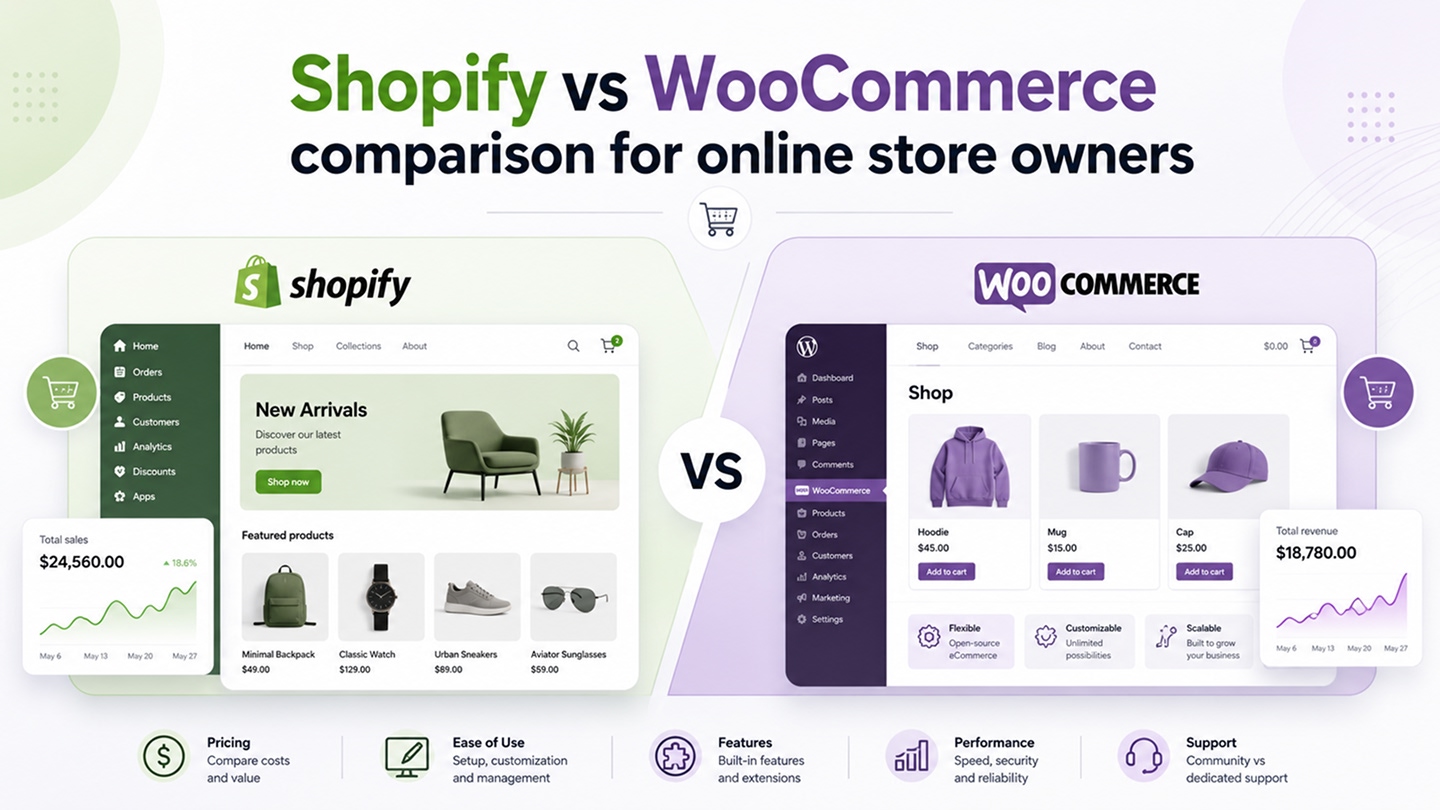
Shopify vs WooCommerce: Which Is Better for Your Online Store?
Shopify vs WooCommerce is one of the most important comparisons for anyone planning to build an online store.
Both platforms can help you sell products online, manage orders, design product pages, and grow an eCommerce business.
The best choice depends on your budget, technical skill, design needs, SEO goals, and long-term growth plan.
Shopify vs WooCommerce: Quick Overview
Shopify is an all-in-one hosted eCommerce platform.
It gives you hosting, online store tools, checkout, inventory management, payment features, sales channels, and business tools from one dashboard.
WooCommerce is an open-source eCommerce platform built for WordPress.
It gives you more control over hosting, data, checkout, features, design, and customization.
What is Shopify?
Shopify is a hosted commerce platform made for people who want to launch and manage an online store with less technical setup.
It is a strong option for business owners who prefer convenience, built-in tools, and a simpler store management experience.
- Hosted eCommerce platform
- Built-in checkout and payment tools
- Easy product and inventory management
- App ecosystem for extra features
- Good choice for fast store launch
What is WooCommerce?
WooCommerce is a free, open-source eCommerce solution for WordPress websites.
It is a strong option for users who want deeper customization, full content ownership, flexible hosting, and more control over the store structure.
- Open-source eCommerce for WordPress
- Flexible hosting and ownership
- Large plugin and theme ecosystem
- Strong content and SEO flexibility
- Good choice for custom online stores
Quick Verdict: Which Platform Should You Choose?
Choose Shopify if you want a simple, hosted, and beginner-friendly way to launch an online store quickly.
Choose WooCommerce if you want more control, deeper customization, flexible hosting, and stronger WordPress content integration.
Choose Shopify
Best for beginners, small teams, fast launches, and businesses that want less technical maintenance.
Choose WooCommerce
Best for WordPress users, developers, content-heavy stores, and businesses that want more ownership.
Best Overall?
Shopify is easier to start. WooCommerce gives more flexibility for custom long-term growth.
Shopify vs WooCommerce Comparison Table
This table gives a simple side-by-side view of the most important differences between Shopify and WooCommerce.
| Category | Shopify | WooCommerce | Better Choice |
|---|---|---|---|
| Ease of Use | Very beginner-friendly with hosting and core store tools included. | Requires WordPress setup, hosting, plugins, and more technical decisions. | Shopify |
| Customization | Flexible, but limited by Shopify theme structure and platform rules. | Highly flexible because it runs on WordPress and open-source tools. | WooCommerce |
| Cost Control | Monthly plans, app costs, theme costs, and possible extra transaction-related costs. | Core plugin is free, but hosting, premium themes, plugins, and maintenance can add cost. | Depends on setup |
| SEO | Good built-in SEO basics for product pages, collections, and store structure. | Very strong SEO flexibility through WordPress, SEO plugins, custom content, and technical control. | WooCommerce |
| Maintenance | Shopify handles hosting, security updates, and platform infrastructure. | You manage hosting, plugin updates, backups, security, and performance. | Shopify |
| Design | Professional themes with clean sections and fast setup. | Large WordPress theme ecosystem with deeper design freedom. | Depends on design needs |
| Scalability | Strong for growing stores that want managed infrastructure. | Scalable with the right hosting, caching, database optimization, and development setup. | Depends on technical team |
Ease of Use
Shopify is easier for beginners because it handles many technical parts for you.
You can create products, manage orders, accept payments, and edit your store from one dashboard.
WooCommerce gives you more flexibility, but it also requires more setup.
You need WordPress hosting, a theme, WooCommerce settings, payment gateways, security, backup, and performance optimization.
Winner for beginners: Shopify
Shopify is usually better for users who want to launch quickly without managing hosting, plugin conflicts, or server performance.
WooCommerce is better for users who already understand WordPress or work with a developer.
Cost: Which One Is More Affordable?
Shopify has predictable monthly platform pricing, but the total cost can increase with premium themes, apps, and payment-related fees.
This makes budgeting easier at the beginning, but app costs can grow as your store needs more features.
WooCommerce core is free, but it is not always free to run a real store.
You may need paid hosting, a premium theme, security tools, backup tools, performance plugins, and paid extensions.
💳
Shopify Cost
Shopify is easier to estimate because it uses monthly plans and paid apps.
🧩
WooCommerce Cost
WooCommerce can be cheaper or more expensive depending on hosting, plugins, and development work.
📈
Long-Term Cost
The real cost depends on traffic, custom features, support needs, and store complexity.
Design and Theme Flexibility
Shopify themes are usually clean, polished, and easy to customize through theme sections.
This is useful for store owners who want a professional design without heavy development work.
WooCommerce themes can be more flexible because they run inside the WordPress ecosystem.
You can use page builders, custom templates, child themes, custom code, and advanced layout systems.
Shopify Design Strengths
- Easy theme setup
- Clean section editing
- Modern storefront layouts
- Good for fast design launch
WooCommerce Design Strengths
- More layout control
- Large WordPress theme market
- Compatible with many builders
- Better for custom design systems
SEO: Shopify vs WooCommerce
Both Shopify and WooCommerce can rank well on Google when the store is built correctly.
The difference is how much control you want over your SEO setup.
Shopify includes basic SEO features for product pages, collection pages, titles, meta descriptions, redirects, and sitemaps.
WooCommerce can go deeper because it runs on WordPress, which is strong for blog content, landing pages, SEO plugins, schema, and custom site structure.
SEO Winner: WooCommerce for control, Shopify for simplicity
WooCommerce is often better for content-heavy SEO strategies.
Shopify is easier for store owners who want solid SEO basics without managing too many technical settings.
Shopify vs WooCommerce: Which Platform Fits Your Business?
The best way to choose between Shopify vs WooCommerce is to look at your business model, technical skill, and long-term growth plan.
If you want a simple hosted platform with less maintenance, Shopify is usually easier to manage.
If you want more ownership, deeper customization, and stronger WordPress flexibility, WooCommerce may be the better choice.
For beginners, the Shopify vs WooCommerce decision often comes down to convenience versus control.
Shopify is more convenient because hosting, checkout, security, and platform updates are handled for you.
WooCommerce gives you more control because you can choose your hosting, plugins, theme structure, checkout experience, and SEO setup.
In the long term, Shopify vs WooCommerce is not only about cost.
It is also about how much freedom you need when your online store grows.
Performance and Maintenance
Shopify handles hosting, security, checkout infrastructure, and many performance-related platform tasks.
This reduces the technical workload for store owners.
WooCommerce performance depends heavily on your hosting, theme quality, plugin choices, caching setup, database health, and image optimization.
A well-optimized WooCommerce store can be fast, but it requires more technical maintenance.
⚡
Speed
Shopify is more managed. WooCommerce depends on hosting and optimization.
🔒
Security
Shopify handles more security by default. WooCommerce requires ongoing WordPress maintenance.
🛠️
Updates
WooCommerce needs plugin, theme, and WordPress updates. Shopify reduces this workload.
Payment, Checkout, and Selling Channels
Shopify has a strong checkout system and built-in tools for selling online, on social channels, and in person.
This is helpful for brands that want a complete commerce workflow from one dashboard.
WooCommerce gives more payment flexibility because you can choose different gateways and customize the checkout experience.
This is useful for stores with special checkout rules, local payment needs, or custom business logic.
Pros and Cons of Shopify
Shopify Pros
- Very easy to start
- Hosting is included
- Clean dashboard for store management
- Strong checkout experience
- Good for non-technical store owners
- Large app ecosystem
Shopify Cons
- Monthly platform cost
- App costs can increase over time
- Less backend control than open-source platforms
- Advanced customization may require Shopify developers
- Some features depend on paid apps
Pros and Cons of WooCommerce
WooCommerce Pros
- Free and open-source core platform
- Full ownership of content and store data
- Highly customizable
- Strong WordPress SEO and content flexibility
- Flexible hosting and payment options
- Large plugin and theme ecosystem
WooCommerce Cons
- Requires hosting setup
- Needs regular updates and maintenance
- Plugin conflicts can happen
- Performance depends on technical setup
- Security and backups are your responsibility
Who Should Use Shopify?
Shopify is a better choice for store owners who want a faster and simpler way to launch an online store.
It is also suitable for teams that do not want to manage hosting, plugin updates, backups, and server performance.
- New store owners who want a quick launch
- Brands that want less technical maintenance
- Businesses that need a clean hosted checkout
- Small teams without WordPress development experience
- Stores that prefer apps over custom development
Who Should Use WooCommerce?
WooCommerce is a better choice for users who want more control over the store and website structure.
It is also suitable for content-heavy businesses that want to combine eCommerce, blogs, landing pages, and custom WordPress features.
- WordPress users who want eCommerce features
- Developers and agencies building custom stores
- Stores that need deeper design flexibility
- Businesses that want more data and hosting control
- Websites that rely heavily on content marketing and SEO
Useful Resources for Shopify vs WooCommerce Research
Before making your final Shopify vs WooCommerce decision, it is useful to check the official platform resources.
You can explore Shopify features, pricing, and store tools on the official Shopify website.
You can also learn more about WooCommerce features and extensions from the official WooCommerce website.
For users who want to build a store with WordPress, the official WordPress website is also a useful resource.
Related eCommerce Guides
If you are still comparing platforms, you can also read more guides in our eCommerce blog.
For design inspiration, explore our Shopify themes and WordPress themes.
If you want to build a WordPress store, you can also check our WooCommerce themes collection.
Shopify vs WooCommerce: Final Recommendation
There is no single winner for every online store.
Shopify is better for simplicity, speed of launch, hosted infrastructure, and easier store management.
WooCommerce is better for flexibility, ownership, WordPress SEO, custom development, and long-term control.
For a beginner who wants to sell quickly, Shopify is usually the easier option.
For a business that needs advanced customization and full control, WooCommerce is often the better long-term choice.
The final Shopify vs WooCommerce choice should match your budget, technical resources, SEO plan, and business goals.
Shopify vs WooCommerce: Best Choice by Store Type
The Shopify vs WooCommerce decision becomes easier when you look at the type of online store you want to build.
For a simple store with a small product catalog, Shopify is usually easier because setup, hosting, checkout, and maintenance are handled in one place.
For a content-heavy store with many landing pages, blog posts, custom layouts, and advanced SEO needs, WooCommerce gives more control.
If you want to launch quickly, the Shopify vs WooCommerce comparison often favors Shopify.
If you want full ownership of your website structure, hosting setup, plugin choices, and long-term customization, the Shopify vs WooCommerce comparison often favors WooCommerce.
For small businesses, Shopify vs WooCommerce is mainly a choice between convenience and flexibility.
For agencies, developers, and advanced store owners, Shopify vs WooCommerce is also a choice between managed infrastructure and open-source freedom.
FAQs About Shopify vs WooCommerce
Is Shopify better than WooCommerce?
Shopify is better for users who want a hosted platform that is easier to set up and manage.
WooCommerce is better for users who want more control, more customization, and stronger WordPress flexibility.
Is WooCommerce cheaper than Shopify?
WooCommerce core is free, but you still need hosting, a theme, plugins, security, and maintenance.
Shopify has monthly platform pricing, but it includes hosting and many core store tools.
Which platform is better for SEO?
WooCommerce usually gives more SEO control because it runs on WordPress.
Shopify is still good for SEO when product pages, collections, images, and content are optimized properly.
Which platform is better for beginners?
Shopify is usually better for beginners because it handles more technical setup.
WooCommerce is better for users who already understand WordPress or have developer support.
Can WooCommerce handle large stores?
Yes, WooCommerce can handle large stores with the right hosting, caching, database optimization, and development setup.
Poor hosting and too many heavy plugins can slow down a WooCommerce store.
Can Shopify be customized?
Yes, Shopify can be customized through themes, sections, apps, and custom development.
However, WooCommerce gives deeper control because it is open-source and built on WordPress.
Final Thoughts
Shopify vs WooCommerce is not just a platform comparison.
It is a decision about how much control, responsibility, cost flexibility, and technical freedom you want for your online store.
Choose Shopify when you want convenience, faster setup, managed infrastructure, and a smoother beginner experience.
Choose WooCommerce when you want ownership, customization, flexible hosting, and stronger WordPress content control.
Both platforms can build a successful online store when the design, products, SEO, speed, and customer experience are handled correctly.
