
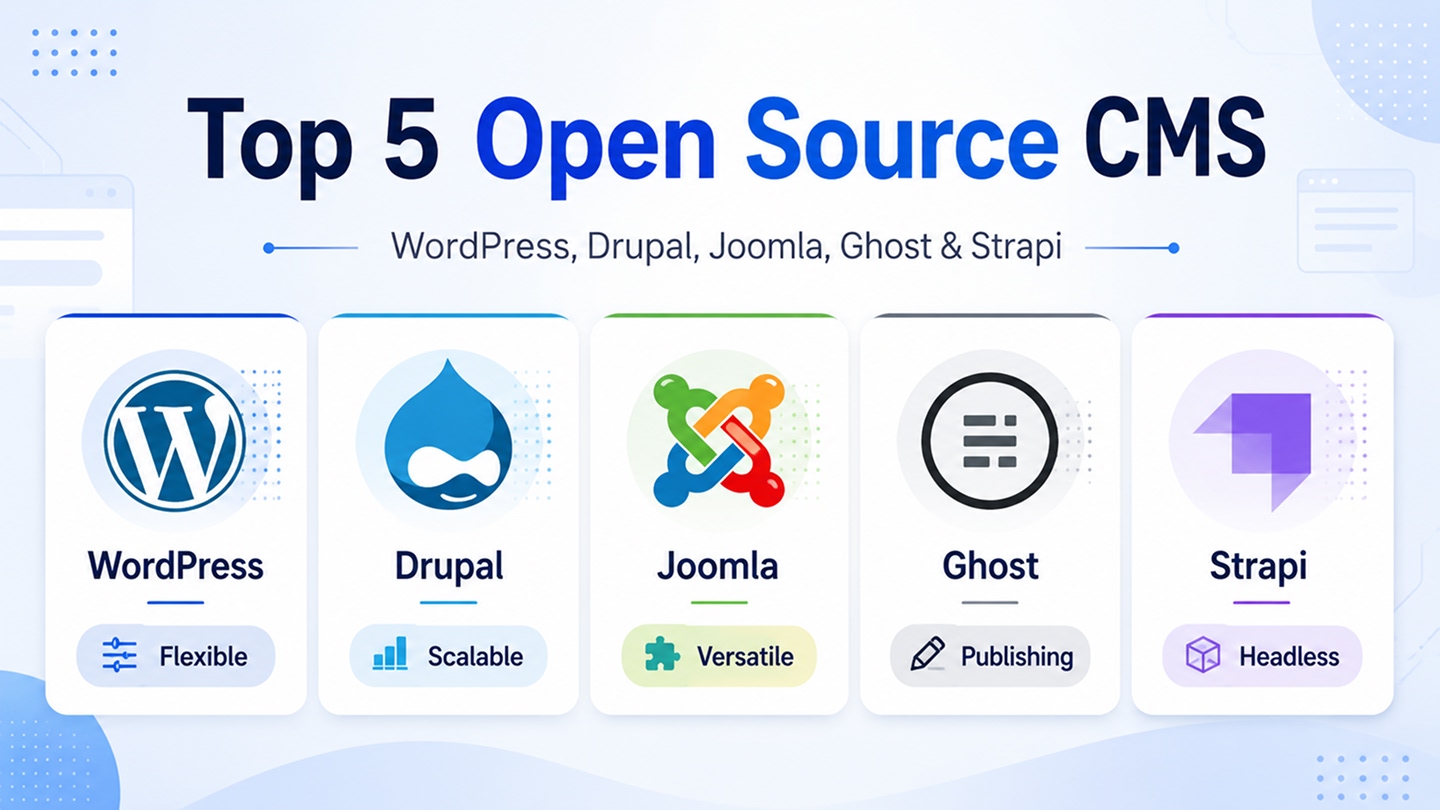
5 Best Open Source CMS Platforms for Modern Websites
Open Source CMS platforms are a smart choice for building websites, blogs, business sites, online communities, and modern digital projects.
A good CMS should help you create, manage, organize, and publish content without building everything from scratch.
In this article, we will explore the top 5 Open Source CMS platforms for modern websites.
These platforms include WordPress, Drupal, Joomla, Ghost, and Strapi.
Each CMS has its own strengths, ideal use case, and technical direction.
Some platforms are better for blogs and business websites.
Others are better for complex portals, content-heavy projects, or headless CMS workflows.
These Open Source CMS platforms are selected for users who want flexibility, content control, community support, and long-term website ownership.
If you are planning to create a blog, company website, documentation site, content platform, or headless project, this guide can help you choose a suitable CMS.
Why Open Source CMS Platforms Matter
The right Open Source CMS can make website management easier, faster, and more flexible.
Instead of editing static files manually, a CMS allows you to manage pages, posts, media, menus, users, categories, and settings from an admin dashboard.
Open source platforms are useful because the source code is available for developers, agencies, and businesses to inspect, customize, and extend.
This gives website owners more freedom compared to many closed-source systems.
An open source CMS can also reduce vendor lock-in.
You have more control over your hosting, data, plugins, themes, integrations, and development workflow.
For beginners, an easy CMS can help launch a website faster.
For developers, a flexible CMS can become a strong foundation for custom projects, APIs, workflows, and scalable content systems.
You can learn more about open source software from the official Open Source Initiative.
You can also explore website publishing and content management concepts from W3C.
Top 5 Open Source CMS Platforms
Below are five strong options for building different types of websites and content platforms.
These Open Source CMS platforms are suitable for blogs, business websites, enterprise content systems, publishing platforms, and headless applications.
1. WordPress – Popular Open Source CMS for Websites and Blogs
WordPress is one of the most popular Open Source CMS platforms for building websites, blogs, portfolios, landing pages, and online stores.
It is a good choice for users who want a flexible CMS with a large ecosystem of themes, plugins, tutorials, and community support.
WordPress works well for personal blogs, company websites, news sites, WooCommerce stores, and content-focused projects.
Its biggest strength is flexibility.
You can start with a simple website and expand it with plugins, page builders, custom themes, and integrations.
For beginners, WordPress is easier to approach than many technical CMS platforms.
For developers, WordPress can also support custom post types, custom fields, REST API, theme development, and advanced workflows.
Why choose WordPress?
WordPress is a strong choice if you want an Open Source CMS with a large ecosystem, strong community, and many website-building options.
Best for:
Blogs, business websites, portfolios, landing pages, online stores, content websites, and small to medium business projects.
Key features:
- Large theme and plugin ecosystem
- Beginner-friendly admin dashboard
- Strong blogging and content management features
- WooCommerce support for online stores
- Custom post types and custom fields support
- Large global community and learning resources
2. Drupal – Powerful Open Source CMS for Complex Websites
Drupal is a powerful Open Source CMS designed for complex, structured, and scalable websites.
It is a good choice for organizations that need strong content architecture, user permissions, multilingual features, and custom workflows.
Drupal is often used for government websites, universities, enterprise portals, community platforms, and large content systems.
Compared to WordPress, Drupal usually has a steeper learning curve.
However, it offers strong flexibility for developers who need advanced content models and strict control over website structure.
If your project needs complex permissions, structured data, and enterprise-level flexibility, Drupal is worth considering.
Why choose Drupal?
Drupal is a strong option if you need a scalable Open Source CMS for complex websites, custom content structures, and advanced user roles.
Best for:
Enterprise websites, government portals, universities, community websites, multilingual platforms, and large content-heavy projects.
Key features:
- Advanced content structure and content types
- Strong user roles and permission system
- Good support for multilingual websites
- Suitable for complex and scalable projects
- Developer-friendly architecture
- Useful for enterprise and public sector websites
3. Joomla – Flexible Open Source CMS for Websites and Portals
Joomla is an Open Source CMS that sits between beginner-friendly website builders and more developer-focused CMS platforms.
It is suitable for users who need more built-in structure than a simple blog system, but do not want a fully complex enterprise CMS.
Joomla can work well for business websites, membership sites, community portals, directories, and multilingual websites.
It includes useful content organization features and flexible menu management.
Joomla also has extensions and templates that help website owners add more features without building everything from scratch.
If you want a balanced CMS for structured websites and content management, Joomla can be a practical option.
Why choose Joomla?
Joomla is a good choice if you want a flexible Open Source CMS with strong built-in features for structured websites and portals.
Best for:
Business websites, membership sites, community portals, directories, multilingual websites, and content-driven platforms.
Key features:
- Flexible content and menu management
- Good option for structured websites
- Supports multilingual website needs
- Extension system for extra functionality
- Useful for community and membership websites
- Balanced choice between simplicity and flexibility

4. Ghost – Open Source CMS for Publishing and Newsletters
Ghost is an Open Source CMS focused on publishing, blogging, newsletters, memberships, and content creators.
It is a strong choice for writers, independent publishers, media brands, newsletters, and content businesses.
Ghost is designed to be clean, fast, and focused on writing.
Unlike larger CMS platforms, Ghost does not try to do everything.
Its strength is helping creators publish content, build an audience, and manage memberships or subscriptions.
If your goal is to build a professional blog, newsletter platform, or content publication, Ghost is a strong option.
Why choose Ghost?
Ghost is a good option if you want an Open Source CMS focused on publishing, content creation, newsletters, and memberships.
Best for:
Blogs, newsletters, creator websites, online magazines, paid content platforms, and independent publishing businesses.
Key features:
- Clean writing and publishing experience
- Newsletter and membership features
- Fast and focused content platform
- Good choice for creators and publishers
- Modern editor for blog content
- Useful for audience and subscription-focused websites
5. Strapi – Open Source Headless CMS for Developers
Strapi is an Open Source Headless CMS built for developers who want to manage content and deliver it through APIs.
It is different from traditional CMS platforms because it does not focus on rendering a complete website by itself.
Instead, Strapi helps you create content models and expose content to front-end applications through APIs.
This makes it useful for headless websites, mobile apps, React projects, Next.js websites, Vue applications, and custom digital products.
Strapi is a strong option for teams that need flexibility between content management and modern front-end development.
If your project needs a headless CMS workflow, Strapi is one of the best open source options to consider.
Why choose Strapi?
Strapi is a strong choice if you want an Open Source CMS for headless architecture, API-first content delivery, and custom development workflows.
Best for:
Headless websites, mobile apps, modern web apps, API-driven projects, developer teams, and custom content platforms.
Key features:
- Headless CMS architecture
- API-first content delivery
- Custom content models
- Useful for React, Next.js, Vue, and mobile apps
- Developer-friendly admin panel
- Flexible option for modern digital products
What Makes a Good Open Source CMS?
A good CMS should make content easy to create, edit, organize, and publish.
It should also match your technical skill level and project goals.
For a simple blog or business site, ease of use may be the most important factor.
For a large organization, permissions, security, multilingual features, and scalability may matter more.
For a modern app or headless website, API support and developer experience can become the main priority.
Before choosing a CMS, check the admin interface, documentation, extension ecosystem, hosting requirements, and long-term maintenance needs.
The best Open Source CMS is not always the most popular one.
The best choice is the platform that fits your content workflow, budget, technical team, and future growth plan.
How to Choose the Best Open Source CMS
When choosing the best Open Source CMS, start with the type of website you want to build.
If you want a blog, company website, or small business site, WordPress is often the easiest starting point.
If you need a complex portal with advanced content architecture, Drupal may be more suitable.
If you want a flexible CMS for structured websites and community features, Joomla can be a good option.
If your main goal is publishing, newsletters, and memberships, Ghost is worth considering.
If you want a headless CMS for modern development, Strapi can be a strong choice.
When comparing Open Source CMS platforms, always consider ease of use, customization, security, performance, extensions, hosting, and developer support.
The right CMS should help you manage content faster and reduce unnecessary technical complexity.
Important Features to Look for in an Open Source CMS
When choosing an Open Source CMS, features should match your real website needs.
A simple CMS with the right features is often better than a complex system that your team cannot maintain.
Ease of Use
The admin dashboard should be clear enough for content editors, marketers, and website owners.
If the CMS is too difficult to use, publishing content can become slow and frustrating.
Customization Options
A good CMS should allow you to customize templates, layouts, fields, content types, and integrations.
This is important when your website grows or your content structure changes.
Security and Updates
Security is important for every website.
You should check how often the CMS is updated and whether the community actively fixes issues.
Plugin and Extension Ecosystem
Plugins and extensions can help you add SEO tools, forms, analytics, eCommerce, security features, and integrations.
A strong ecosystem can save development time and reduce project cost.
Scalability
Your CMS should support your website as traffic, content, users, and features grow.
For larger projects, scalability and performance should be considered from the beginning.
Top 5 Open Source CMS Comparison Table
| CMS | Best For | Main Benefit | Recommended For |
|---|---|---|---|
| WordPress | Blogs and business websites | Easy to use with a huge ecosystem | Beginners, bloggers, small businesses, and agencies |
| Drupal | Complex and scalable websites | Advanced content structure and permissions | Enterprises, universities, and government websites |
| Joomla | Structured websites and portals | Balanced flexibility and built-in features | Business sites, directories, and community platforms |
| Ghost | Publishing and newsletters | Clean writing and membership features | Creators, writers, publishers, and media brands |
| Strapi | Headless CMS projects | API-first content management | Developers, apps, and modern front-end projects |
Benefits of Using Open Source CMS Platforms
Using an Open Source CMS can help you build websites with more flexibility and long-term control.
You can choose your hosting, customize the code, install extensions, and manage your content workflow based on your project needs.
More Control
Open source platforms give you more control over your website files, database, hosting, and custom development options.
Flexible Customization
You can customize themes, templates, content types, plugins, APIs, and integrations to match your website goals.
Community Support
Popular open source CMS platforms usually have active communities, documentation, tutorials, and developer resources.
Lower Vendor Lock-In
Because you are not fully tied to one closed platform, you have more freedom to move, extend, or rebuild your website later.
Better Long-Term Ownership
An open source CMS can help businesses and creators maintain better ownership of their website and content strategy.
Which Open Source CMS Should You Choose?
If you want an easy and flexible CMS for blogs and business websites, WordPress is a strong choice.
If your website needs complex content structure, permissions, and scalability, Drupal may be more suitable.
If you want a balanced CMS for structured websites, directories, or community features, Joomla can be a practical option.
If your goal is publishing, newsletters, and memberships, Ghost is worth considering.
If you are building a headless website, mobile app, or API-driven project, Strapi can be a strong option.
These Open Source CMS platforms are suitable for different users, from beginners and bloggers to developers and enterprise teams.
You can also read more useful website guides in our blog or explore our WordPress themes to improve your website design and content workflow.
FAQs About Open Source CMS Platforms
What is an Open Source CMS?
An Open Source CMS is a content management system with source code that can be viewed, modified, and extended by developers and users.
Which Open Source CMS is best for beginners?
WordPress is often the best starting point for beginners because it has a large ecosystem, many tutorials, and an easy-to-use admin dashboard.
Which CMS is best for complex websites?
Drupal is a strong choice for complex websites that need advanced content structures, permissions, multilingual features, and scalability.
Which CMS is best for blogging and newsletters?
Ghost is a good option for blogging, publishing, newsletters, memberships, and content creator websites.
Which CMS is best for headless websites?
Strapi is a strong option for headless CMS projects because it focuses on API-first content management and modern development workflows.
Is Joomla still useful for websites?
Yes, Joomla can still be useful for structured websites, business portals, directories, membership sites, and multilingual projects.
Are open source CMS platforms secure?
Open source CMS platforms can be secure if they are updated regularly and managed properly.
You should always use trusted extensions, strong passwords, reliable hosting, and regular backups.
Should I choose a CMS only because it is popular?
No. Popularity is useful, but you should choose a CMS based on your website goals, technical skills, content structure, budget, and long-term maintenance needs.
Before choosing one of these Open Source CMS platforms, compare the admin dashboard, content workflow, extension ecosystem, security model, hosting needs, and developer support.
Final Thoughts
Choosing the right Open Source CMS is an important step when building a successful website or content platform.
A good CMS helps you manage content more easily, improve your workflow, and build a website that can grow over time.
WordPress, Drupal, Joomla, Ghost, and Strapi are all useful options for different types of websites.
WordPress is great for blogs, business websites, and flexible website building.
Drupal is suitable for complex, scalable, and enterprise-level projects.
Joomla is useful for structured websites, portals, and community platforms.
Ghost is ideal for publishers, newsletters, and content creators.
Strapi is best for developers who want a headless CMS and API-first content management.
Overall, the best CMS depends on your content goals, technical skill, website structure, and long-term maintenance plan.
If your goal is to build a flexible, reliable, and future-ready website, these five open source CMS platforms are strong options to consider.